Manufacturing IT / OT Cyber-Physical Network: Secure, Segmented, & Resilient
Secure manufacturing network segmentation, access control, infrastructure resilience, centralized logging, and operational continuity validation.
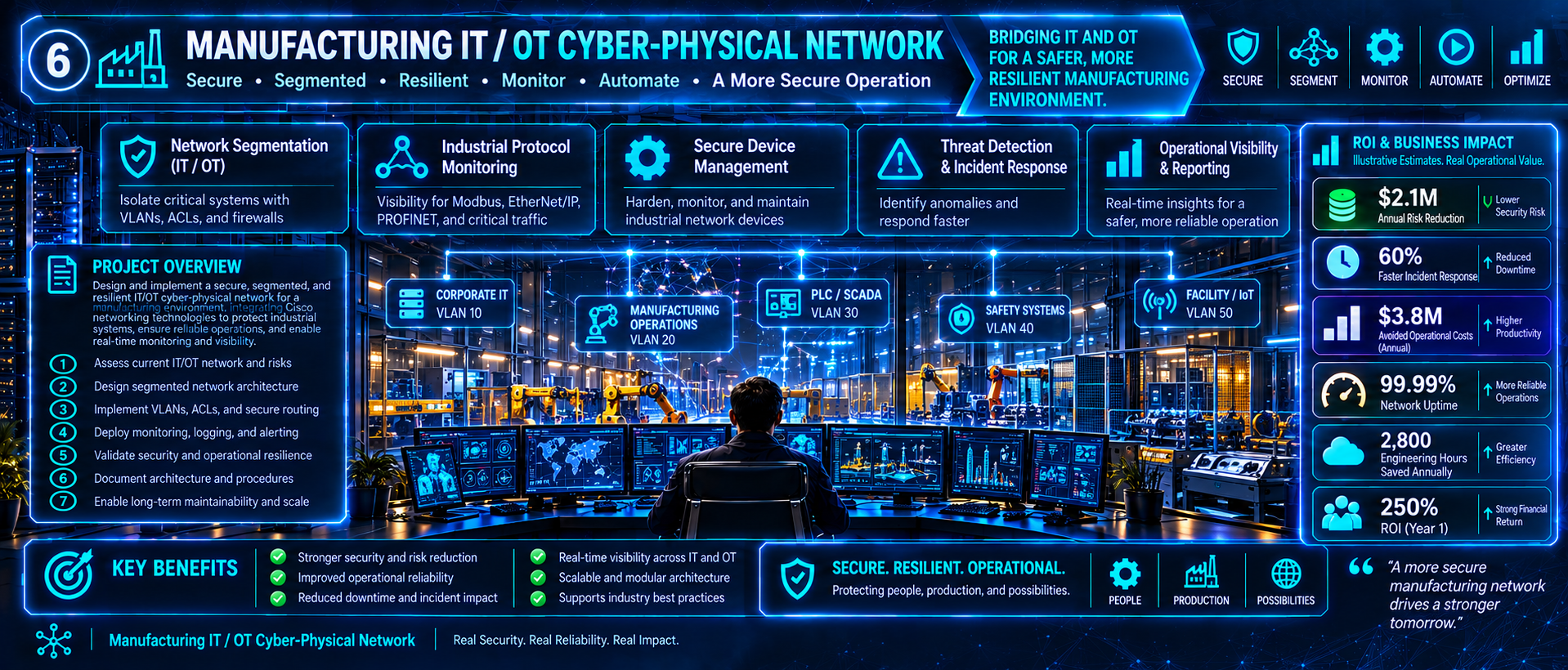
Engineering Problem
Manufacturing environments require secure separation between corporate IT, engineering, operational technology, guest access, and shared infrastructure services without compromising production availability. Inadequate network segmentation, permissive access policies, and insufficient infrastructure redundancy can expose critical systems to unauthorized traffic, operational disruption, and cascading failures. Engineering teams need defense-in-depth network architectures that enforce controlled communication, maintain service visibility, and support reliable operations during network faults and security events.
Technical Solution
Designed and implemented a simulated manufacturing IT/OT network using Cisco Modeling Labs, VLAN segmentation, IEEE 802.1Q trunking, inter-VLAN routing, and access control lists to isolate corporate, engineering, operational, guest, services, and management networks. Configured router-based NAT, DHCP services, secure administrative access, Rapid PVST+ redundancy, NTP synchronization, and centralized Syslog reporting to support resilient infrastructure operations. Validated network connectivity, guest access restrictions, ACL counters, service availability, and spanning-tree reconvergence through structured testing and documented CLI evidence.
Business & Technical Value
Business Value:
- Reduce cybersecurity exposure and operational risk through network segmentation, controlled access policies, and defense-in-depth architecture.
- Improve manufacturing continuity and infrastructure resilience through redundant network paths, automated failover, and validated service availability.
- Strengthen operational visibility, security accountability, and incident investigation through centralized event logging, time synchronization, and documented validation procedures.
Technical Value:
- Demonstrate Cisco network engineering, VLAN segmentation, IEEE 802.1Q trunking, inter-VLAN routing, ACL enforcement, NAT, and DHCP.
- Implement Rapid PVST+ redundancy, root bridge configuration, link-failure testing, NTP synchronization, and centralized Syslog monitoring.
- Validate guest isolation, access restrictions, routing, network services, failover behavior, and security controls using repeatable CLI testing and engineering evidence.
Tools & Capabilities
Core Tools:
Supporting Technologies:
Implementation & Validation Highlights
- Network Segmentation & Access Control: Implemented six VLANs for Corporate, Engineering, OT, Guest, Services, and Management networks; validated IEEE 802.1Q trunking, inter-VLAN routing, DHCP, NAT translations, guest isolation, and ACL enforcement through CLI verification and traffic testing.
- Infrastructure Redundancy & Resilience: Configured Rapid PVST+ with a designated primary root bridge and redundant switch connections; tested link failures, alternate forwarding paths, and spanning-tree reconvergence to verify network continuity during simulated infrastructure disruptions.
- Security Monitoring & Service Validation: Configured centralized Syslog reporting, NTP synchronization, secure login banners, and infrastructure services; verified ACL counters, routing behavior, device connectivity, synchronized logging, and all seven required engineering functionality checkpoints.
Return on Investment (ROI)
Explore the supporting portfolio
The canonical engineering documentation and infographics remain in the separate public portfolio repository.
Explore Project 06 on GitHub ↗